
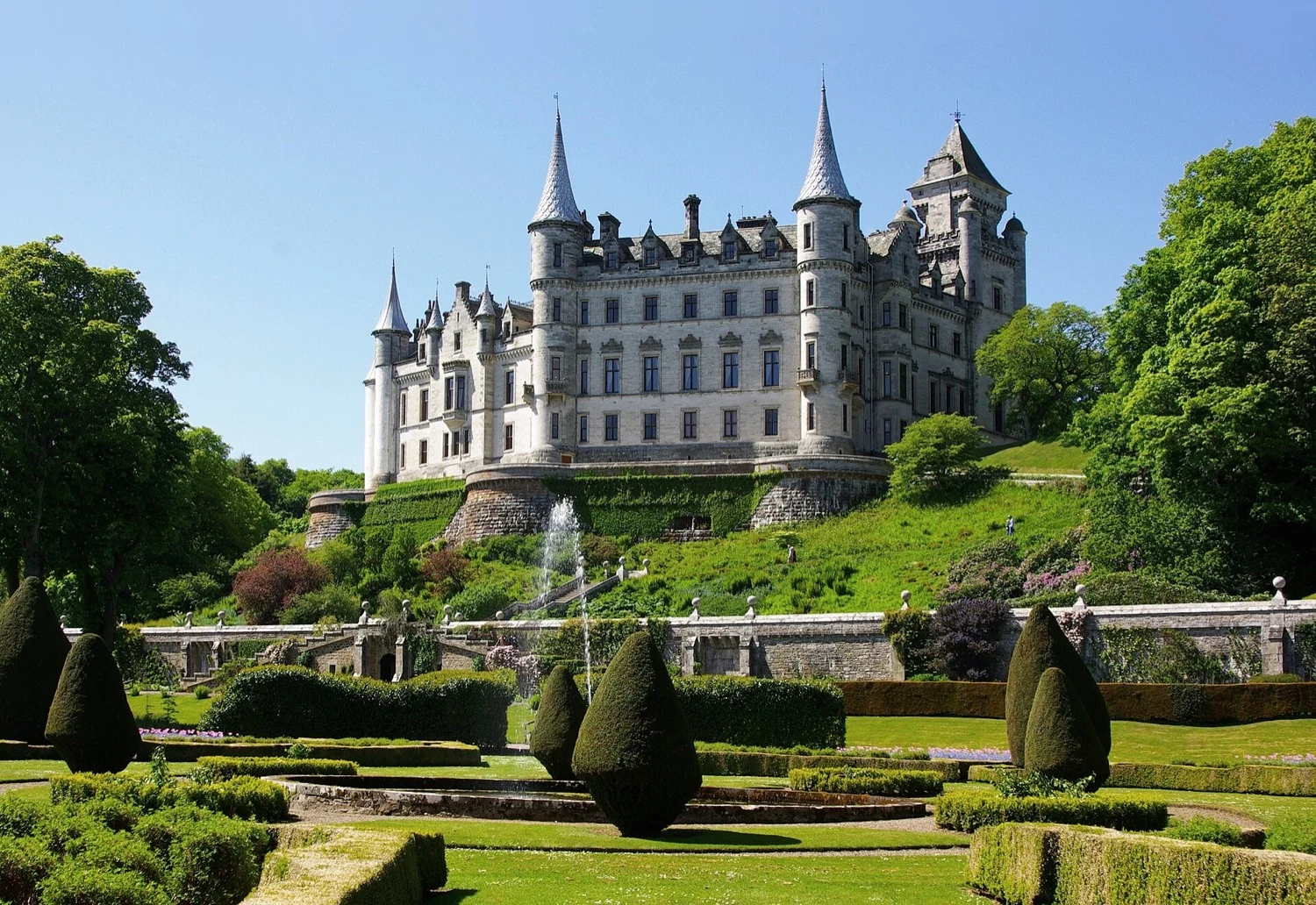
At Golspie, in Sutherland, Dunrobin has been since the Middle Ages the seat of the Earls and then Dukes of Sutherland. Beneath its spectacular Scots-baronial and French-Renaissance envelope (nineteenth century) hides an old square keep, around which the transformation into a residence began in the Renaissance.
A wrapped keep
In the sixteenth century, the earldom of Sutherland passed to the Gordon family when the 8th Earl gave his daughter Elizabeth in marriage to Adam Gordon — a major Highland dynastic alliance. The old medieval tower keep (walls ~1.8 m thick), still buried at the heart of the present building, was then gradually given residential additions: the start of the passage from a defensive fortress to a residence. To see: the primitive keep at the castle's core, the French-style gardens facing the Dornoch Firth.
Did you know?
The passage of the earldom of Sutherland to the Gordons, in the sixteenth century, came not through war but through a marriage: an heiress, Elizabeth, wedding a Gordon. In the Highlands of the Renaissance, a marriage contract could move a whole earldom more surely than a battle.
Notes
Dunrobin Castle lies at Golspie, Sutherland; a private castle open to the public. The Renaissance layer is modest, largely covered by the nineteenth-century campaigns. Hours to check.
Quiz
- Which family received the earldom of Sutherland by marriage in the sixteenth century?
- The Gordons
- The Campbells
- The Douglases
- What does Dunrobin's nineteenth-century envelope hide?
- An old square medieval keep
- A Roman villa
- An abbey
- Which firth do its gardens face?
- The Dornoch Firth
- The Thames
- Loch Ness